3. BMS1810 Battery Connection
BMS1810 measures up to 18 cells in series on the board and up to 8 BMS1202 slave modules over the isolated daisy chain. This page first shows the BMS1810 in a typical battery system, then how to wire the supply and the button, the cells, the temperature sensors, the current sensor, the slave modules, the outputs and inputs and the communication ports, and what to set in LiMon™ afterwards. The connector numbers are those of the pinout.
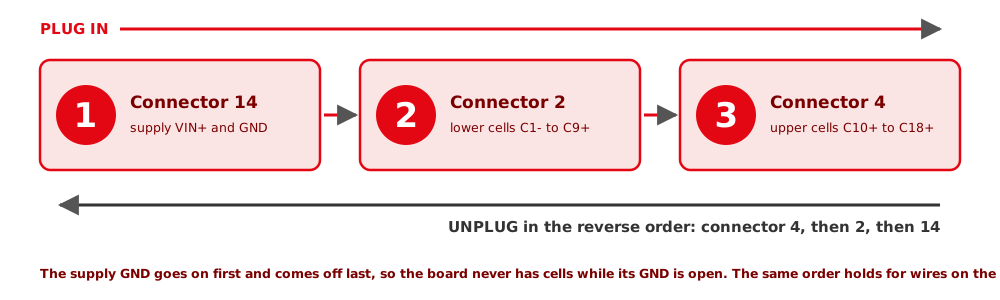
Connection order: supply first, cells from the bottom up
The BMS1810 must never have cells connected while its supply GND (connector 14 pin 4) is open. Plug in connector 14, then connector 2, then connector 4; unplug in the reverse order.
3.1 BMS1810 in a Battery System
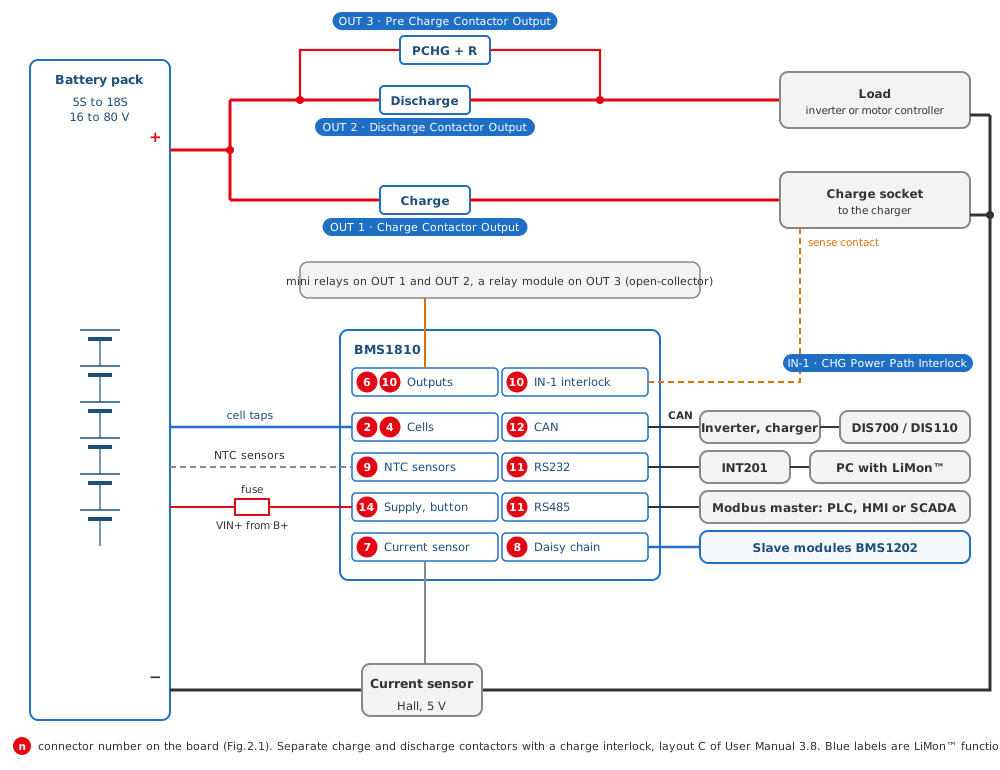
In a typical system the BMS1810 measures the cells and the temperatures of the pack and the pack current with a Hall sensor on the negative cable. It switches a separate discharge path to the load, with a precharge branch, and a charge path to the charge socket; the charge and discharge contactors are switched by mini relays on the high-side outputs OUT 1 and OUT 2, the precharge contactor by a relay module whose logic input is driven by the open-collector output OUT 3. The sense contact of the charge socket goes to input 1, set to CHG Power Path Interlock, so that the pack cannot discharge while the charge cable is plugged in. The BMS runs from the pack through a fuse, talks to the inverter, the charger and a DIS700 or DIS110 display over CAN, to a PC with LiMon™ over the service port and to a Modbus master over RS485. A pack with more than 18 cells adds slave modules on the daisy chain.
Fig.3.1.1: BMS1810 in a Typical Battery System
Tip
The figure uses layout C of User Manual 3.8 Power Path: separate charge and discharge contactors with a charge interlock. One main contactor for both paths is layout A there; the precharge itself is in User Manual 3.9 Precharge.
3.2 Power Supply and User Button
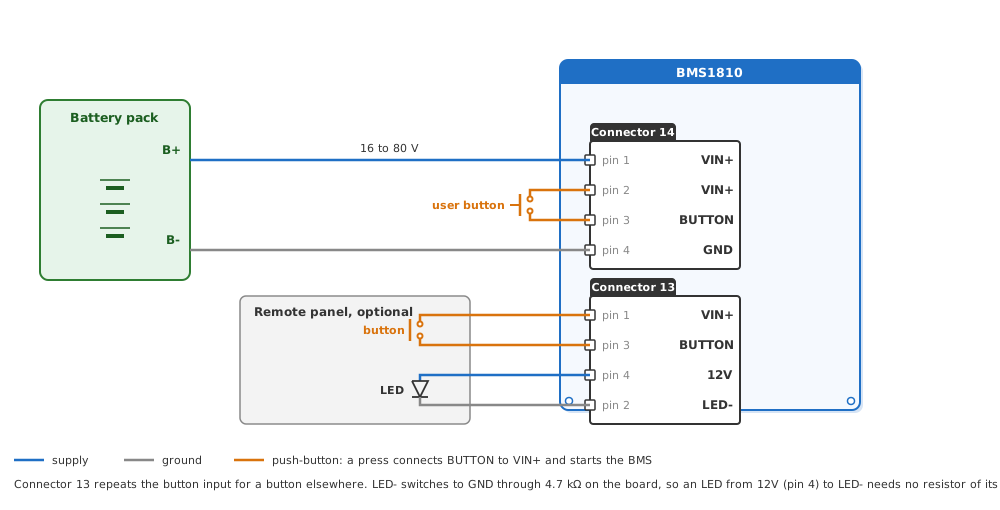
BMS1810 runs from 16 to 80 V on VIN+ of connector 14, normally straight from the pack. The board starts with a press of the user button, a push-button between VIN+ (connector 14 pin 2) and BUTTON (pin 3). Connector 13 carries the same button input for a button elsewhere, with VIN+ on pin 1, and LED- on pin 2 for an LED from its 12V pin 4.
Fig.3.2.1: BMS1810 Supply and User Button
Danger
Keep the connection order at the top of this page: connector 14 first, then connector 2, then connector 4; unplug in the reverse order.
Tip
What the button does after the start, and how the BMS shuts itself down, is in User Manual 3.11 Button and Shutdown.
3.3 Cell Connection
Warning
Keep the connection order at the top of this page: connector 14 first, then connector 2, then connector 4; unplug in the reverse order.
Warning
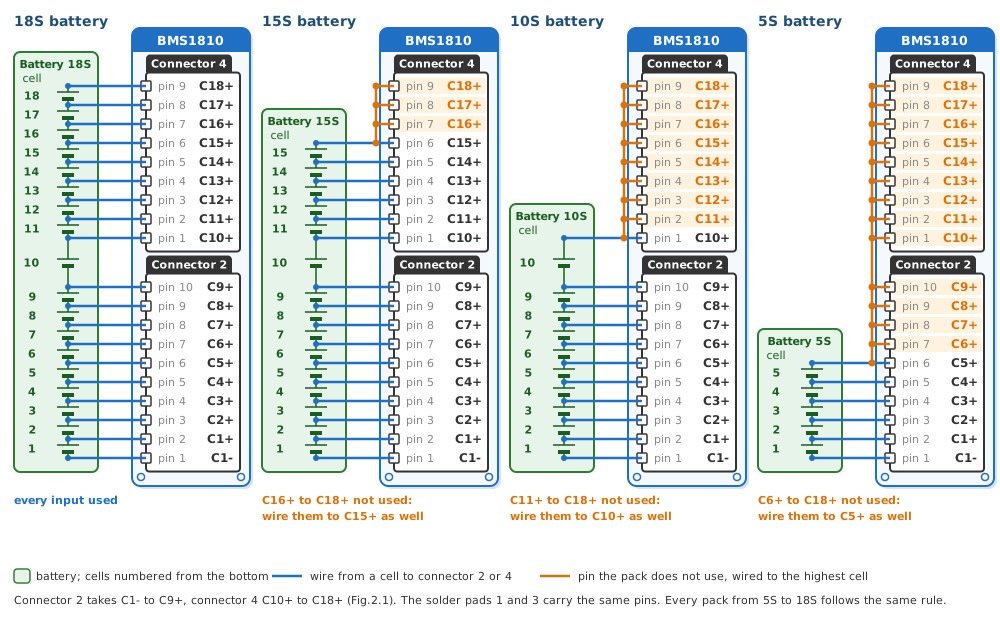
Take C1- and the tap of the top cell on wires of their own, not from the B- and B+ power cables of the pack. A wire shared with the load current drops voltage and gives wrong cell readings.
Info
Tie the unused inputs to the highest cell, on the cell measurement cable or at the connector; open inputs give wrong cell measurements.
Fig.3.3.1: BMS1810 5S to 18S Battery Cell Connections
Tip
After the wiring, check the cell count as 3.9 describes.
3.4 Temperature Sensor Connection
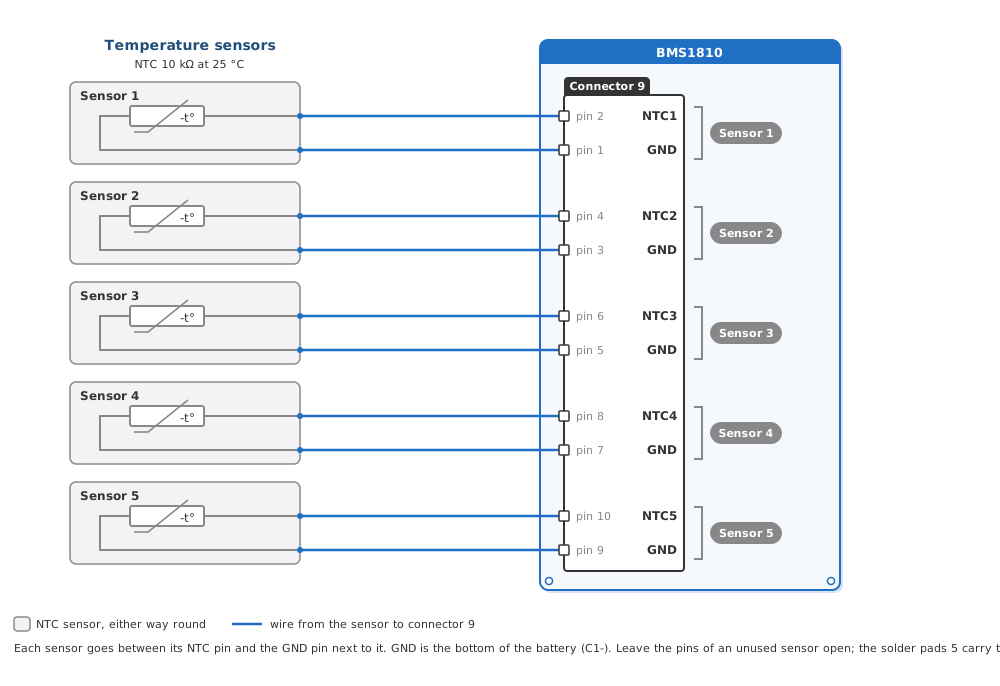
Up to five NTC sensors connect to connector 9, each between its NTC pin and the GND pin next to it; in LiMon™ Live View they are T1 to T5. The solder pads 5 carry the same pins.
Fig.3.4.1: BMS1810 Temperature Sensor Connection
Tip
Leave the pins of an unused sensor open: an input without a sensor is ignored. Check in Live View that every connected sensor reads a value.
3.5 Current Sensor Connection
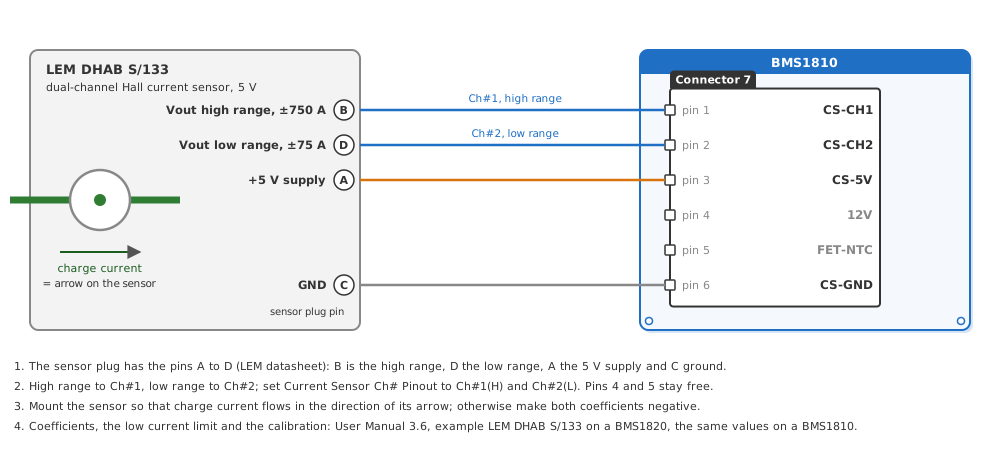
A Hall current sensor with a 5 V supply connects to connector 7: its output to CS-CH1 (pin 1), a second range of a dual-channel sensor to CS-CH2 (pin 2), its supply to CS-5V (pin 3) and CS-GND (pin 6). The figure shows a LEM DHAB S/133, a dual-channel sensor whose high range goes to Ch#1 and its low range to Ch#2. The sensor type, the channels and the coefficients are set in LiMon™; see User Manual 3.6 Current Measurement, whose values for this sensor on a BMS1820 hold for the BMS1810 as well.
Fig.3.5.1: BMS1810 Current Sensor Connection, LEM DHAB S/133
3.6 Slave Modules via Isolated Daisy Chain Communication Port
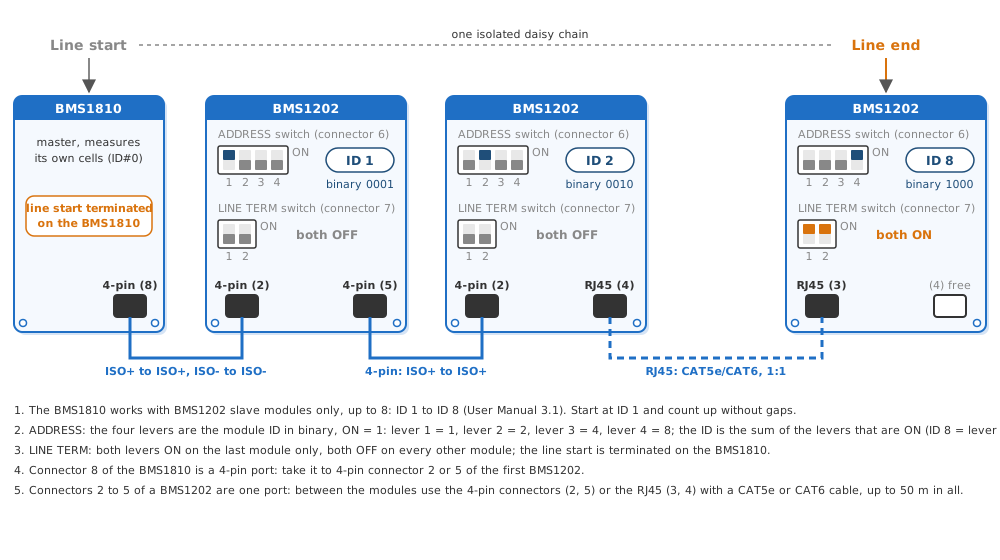
BMS1810 drives up to 8 BMS1202 slave modules over one isolated daisy-chain port, the 4-pin connector 8. The start of the line is terminated on the BMS1810 board. Each BMS1202 takes its module ID, 1 to 8, from its ADDRESS switch, and the last one closes the line with both LINE TERM levers ON.
Fig.3.6.1: BMS1810 Isolated Daisy Chain to the Slave Modules
Tip
Use twisted-pair cable from connector 8. Between the slaves either the 4-pin connectors (ISO+ to ISO+, ISO- to ISO-) or the RJ45 connectors with a CAT5e or CAT6 cable will do, up to 50 m. How each slave is wired in and out, how it takes its module ID and how the line end is closed is on BMS1202 Battery Connection.
3.7 Outputs and Inputs
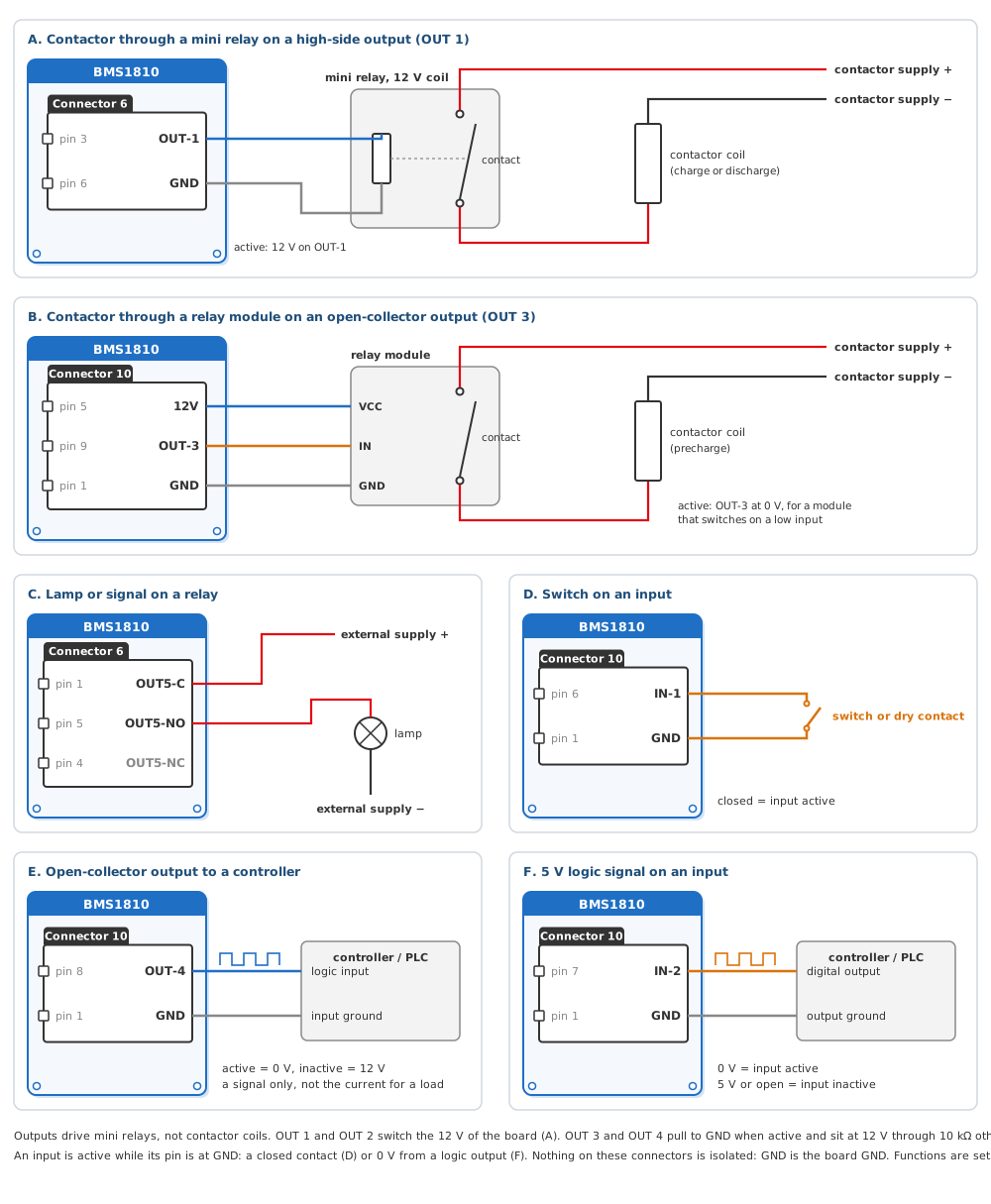
The high-side outputs OUT 1 and OUT 2 on connector 6 switch the 12 V of the board; the open-collector outputs OUT 3 and OUT 4 on connector 10 pull to GND when active and sit at 12 V through 10 kΩ otherwise. OUT 1 and OUT 2 drive mini relays; OUT 3 and OUT 4 sink a few mA only and drive logic inputs, such as a relay module or a controller input. None of them drives a contactor coil: a contactor is switched by a relay contact, from its own supply. The relays OUT 5 (connector 6) and OUT 6 (connector 17) are free contacts (COM, N.O., N.C.). The inputs on connector 10 are active while their pin is at GND, through a closed contact or a 0 V logic signal (5 V or open is inactive). Nothing on these connectors is isolated: GND is the board GND. What each output and input does is set in LiMon™; see User Manual 3.10 Inputs and Outputs, whose Table.3.10.4 lists the pin of every LiMon™ number.
Fig.3.7.1: BMS1810 Output and Input Examples
Warning
Do not connect a contactor coil straight to an output; use a mini relay or a relay module. This page gives no current rating for the outputs, so check any other load with LiBat™ first.
3.8 Communication Ports and Termination
RS232 No.0 (the service port for LiMon™) and RS485 are on connector 11, CAN on connector 12; RS232 No.1 on connector 12 is not used by the current firmware. The ports are not isolated: their GND is the board GND. CAN and RS485 are lines with a 120 Ω termination at each of their two ends, and the BMS1810 has none on the board: when it sits at an end of a line, fit 120 Ω between CAN H and CAN L (connector 12 pins 6 and 3) or between RS485 A and B (connector 11 pins 5 and 2), for example in the cable plug. The settings of the ports are in User Manual 4.1 Communication Ports.
3.9 Settings in LiMon™ and First Check
After the wiring, set the cells and the slave modules in LiMon™ and restart the BMS so that it finds them:
- Module ID#0: the cell count measured on connectors 2 and 4 of the BMS1810 (5 to 18).
- Slave Module Type Selection: has no effect on the BMS1810, which works with BMS1202 slave modules only.
- Module ID#n: the cell count of every BMS1202, from ID#1 up, up to 8 modules (ID#8); --- for every ID without a board.
- Parallel Group: leave at ---; set it only for strings of modules in parallel (User Manual 3.1 Battery Topology).
- Save, restart the BMS and check in Live View that every module is there with the cell count you set. The full procedure is in 2.1 Commissioning Checklist.
Table.3.9.1: Wiring Faults and What the BMS Reports
| Wiring fault | Event | What to check |
|---|---|---|
| A cell tap missing or loose, an unused input not tied to the highest cell, or a cell count in LiMon™ that does not match | (26) Cell Connection Error | Connected Cells of the module, then its cell connectors and the cell count in LiMon™ |
| A daisy chain cable or connector broken, or a slave module below 11 V | (29) Slave Module Communication Error | Which module is missing in Live View, then its cables and its cell voltages |
| A temperature sensor not connected or its wire broken | none; the input is ignored | That the sensor reads a value in Live View |
After a fault is repaired, restart the BMS. All events and their causes are in 6.1 Events and What to Do.